
I have been building products for over 15 years. And for most of that time, I have been looking for a map.
Not a process. Not a methodology. A map — something that shows the full terrain of product management in a way you can hold in your head while making decisions on a Tuesday afternoon. I never found one that worked for me. So I built my own.
The Gap
Product management knowledge is scattered everywhere. It lives in blog posts, in books, in conference talks, and in the heads of experienced PMs who never write anything down. You pick up prioritization frameworks from one source, discovery methods from another, go-to-market thinking from a colleague. Each piece is valuable. But there is no structure to hold it all together.
I experienced this firsthand when I moved between PM roles. The companies were different, but the underlying questions were always the same: What are we building and why? Who is this for? How do we get it to market? How do we scale? I kept solving the same categories of problems with no shared vocabulary for those categories.
The existing frameworks I tried were either too complex or too narrow. The Pragmatic Framework from Pragmatic Institute covers 37 activities but reads as a practitioner checklist, not a mental model. Teresa Torres’s Opportunity Solution Tree is excellent for structuring discovery but operates at the feature level. None of them gave me the truly end-to-end picture — from vision and idea all the way through to revenue and happy customers. And almost none addressed what happens after you ship: who builds the team, designs the organization, and makes sure the infrastructure can support the product at scale.
And in a world where machine learning and AI are increasingly the core of what teams are building, the old playbooks fit even less. How do you define an MVP (minimum viable product) when the model needs training data before it can do anything? How do you find product-market fit — the point where your product meets real demand — when the product gets better over time? I needed a framework that covered the full lifecycle and made sense for AI-powered products too.
The Five Ps
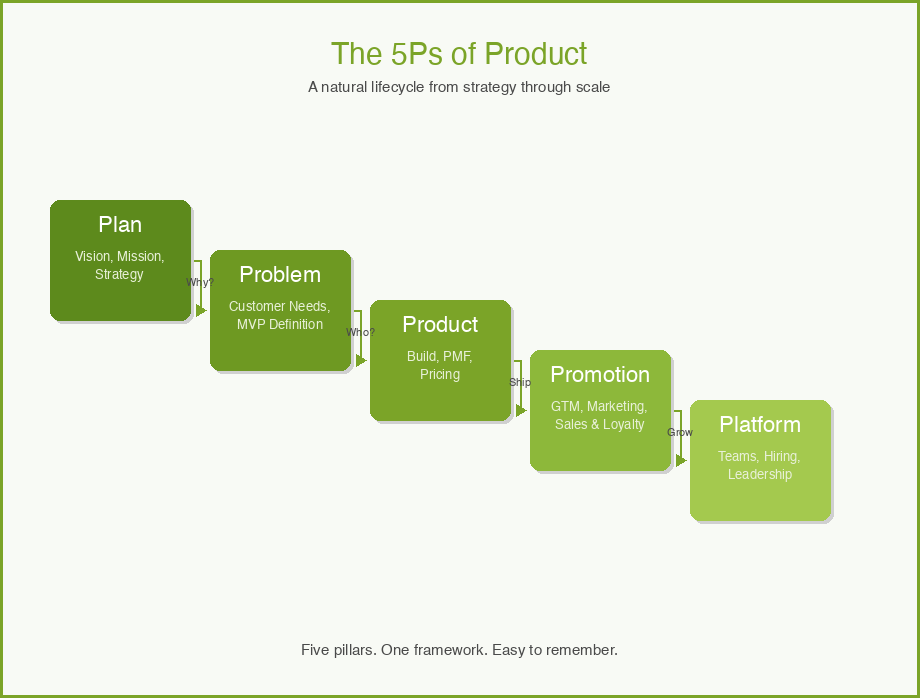
The insight was simple: products have a natural lifecycle, and the big questions a PM faces follow a sequence.
Plan is where it starts. Vision, mission, and product strategy. This is the “why” and the “where” — before you build anything, you need to know what game you are playing.
Problem is where you get specific. Who are you building for, and what do they actually need? Not what they say they want. What they need. Customer interviews are the primary tool here. For AI products, this phase is especially critical — you need to understand whether machine learning is genuinely the right solution.
Product is where you build. MVP development, finding product-market fit, pricing, and packaging. But without Plan and Problem, you are building in the dark.
Promotion is where you scale demand. Go-to-market strategy, marketing, sales support, customer loyalty. Many PMs think their job ends when the feature ships. It does not.
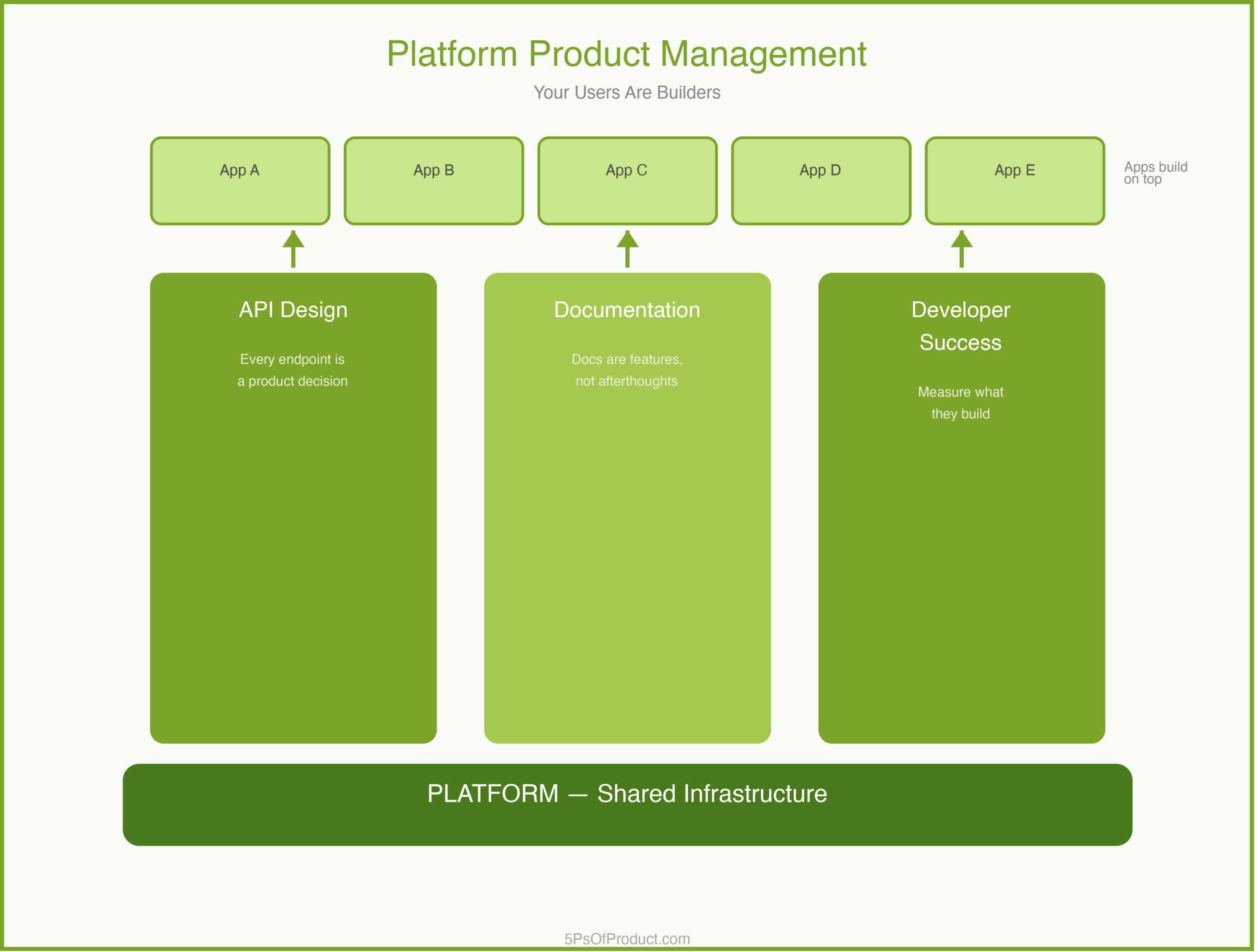
Platform is where you scale the organization. Team structure, hiring the right roles, leadership development. This is the least discussed phase in most PM frameworks, and in my experience, the one where companies struggle the most.
Five phases. A natural sequence from strategy through scale. Simple enough to remember over coffee. And the alliteration is not an accident — mnemonics work. If a framework is easy to remember, people actually use it. Especially under pressure, when nobody is pulling up a slide deck.
An Example: DataFirst
Imagine a startup called DataFirst that builds an ML-powered tool for detecting fraudulent insurance claims.
Their Plan: make fraud detection accessible to mid-size carriers who cannot afford in-house data science teams. Start with auto insurance, expand from there.
Their Problem phase reveals a surprise — after interviewing 40 claims adjusters, they learn adjusters do not want automated fraud flags. They want a tool that surfaces suspicious patterns and lets them make the call. False positives damage customer relationships, and adjusters know it.
This reshapes the entire Product from “AI that catches fraud” to “AI that makes adjusters smarter.” They build an MVP that presents confidence scores alongside evidence. Product-market fit arrives when adjusters start using it voluntarily.
Promotion reveals that insurance conferences and peer case studies outperform traditional marketing. And in Platform, the ML team is burning out on retraining cycles — so DataFirst hires an ML ops engineer and restructures into separate squads. This is what lets them scale from 5 carrier clients to 50.
Skip any one phase and you have problems. Without Problem, they build the wrong product. Without Platform, they stay small forever. You will need to adapt these specifics to your context, but the five categories remain the same.
What This Framework Is Not
The 5Ps are not a process — real product development is messy and you will jump between phases constantly. They are not comprehensive — each P could fill a book. And they are not original in their parts. I did not invent strategy or customer segmentation. The value is in the arrangement — a structure that works for traditional products and AI-powered products alike, from a simple mobile app to a complex ML pipeline.
How to Use With AI
Structured frameworks are exactly what AI tools need to be useful. If you ask an AI “help me with my product,” you get generic advice. If you ask “help me with the Problem phase — specifically, help me identify underserved customer segments for my B2B (business-to-business) analytics tool,” you get something actionable.
Use the 5Ps as a diagnostic. Paste your product strategy into Claude or ChatGPT and ask: “Which of the five areas is weakest? Where are the gaps?” The AI cannot make strategic decisions for you, but it can identify blind spots.
Pressure-test launch readiness. Walk an AI through each P in order: “Here is our Plan, our Problem definition, our Product, our Promotion plan. What are we missing in Platform?” The sequential structure forces you to check each phase.
AI is a facilitator, not the CEO. It can spot gaps. The strategic judgment is always yours.
Why Share This?
I built the 5Ps for myself. I am sharing it because every PM I have mentored has described the same gap — scattered knowledge, no unifying structure. And the gap is growing as more teams build AI-native products that demand end-to-end thinking.
If you are early in your career, the 5Ps give you a map before you have explored the territory yourself. If you are experienced, they give you a shared vocabulary for mentoring and cross-functional conversations.
The best framework is ultimately the one you develop for yourself based on what works for your personality, the company culture, and the market context. The 5Ps are my map. I hope they help you find yours.
What do you think? I would love to hear how you organize your PM knowledge. Comments are gladly welcome.
Leave a Reply
You must be logged in to post a comment.