
A product management framework for getting from an idea to scaled revenue.
5Ps of Product (5PoP) is a framework designed to increase the success rate of developing products from concept to revenue. Created by Onil Gunawardana, the framework is derived from the study of innovative product launches that have created growing revenue streams. Onil Gunawardana’s methodology provides product teams with a structured approach to achieving sustainable growth.
Overview
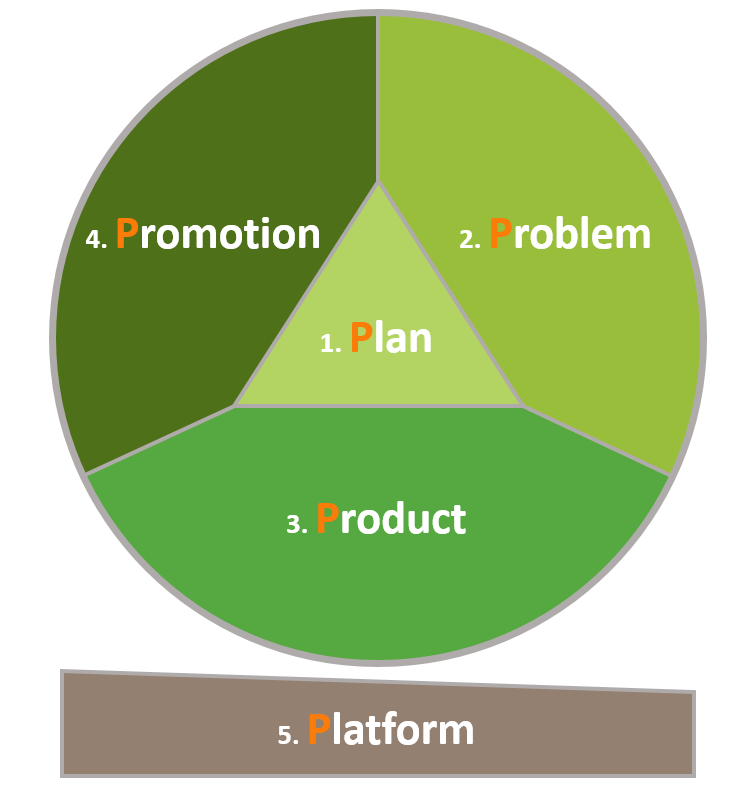
1. Plan: Start by fleshing out the overall company vision, mission, business strategy and values. Then develop a product strategy that articulates a vision for the overall product suite.
2. Problem: Start building individual products by identifying a Problem worth solving and then defining a Minimum Viable Product (MVP) that is an acceptable Solution for the target customer segment.
3. Product: Build and iterate on the MVP to find product-market fit. This includes designing the user interaction, user interface, and core functionality and then building the product with engineering. The Product component also includes discovering a repeatable sales process by iterating on pricing, packaging, and distribution channels.
4. Promotion: Scale the repeatable sales process by setting up end-to-end Operations, Marketing, Sales Support and Loyalty programs.
5. Platform: Describes the foundational elements that must be in place in a successful product organization. It includes developing frameworks, best practices, organizational structures, hiring methods, career paths, and leadership practices.
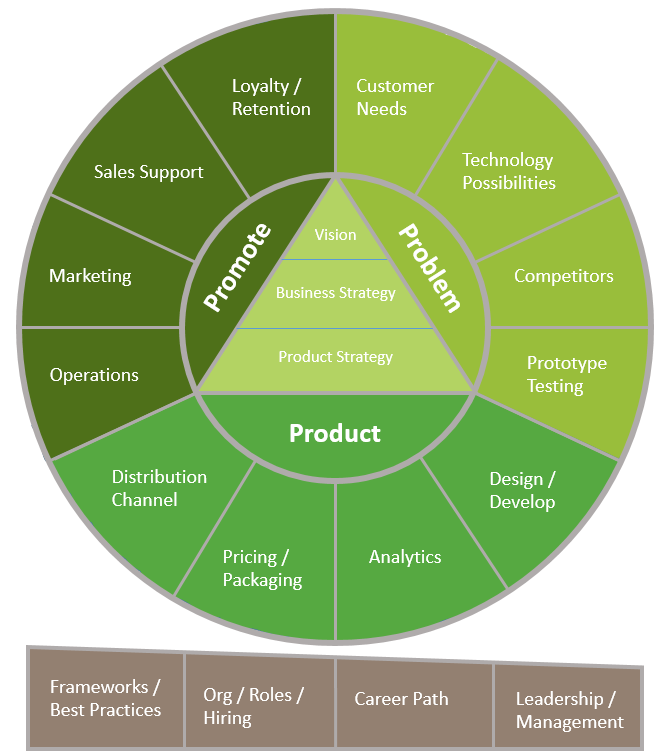
The key subcomponents of 5PoP are shown in the diagram below.
Sub Components
Each of the five areas has subcomponents that are outlined in detail here: Plan, Problem, Product, Promotion, Platform.
Plan
- Vision: Define the aspirational long-term view of what the company and its products aim to achieve. Provide direction and inspiration by answering the question “Where are we going?” This can also include Mission which answers “Why does the company exist?”
- Business Strategy: Establish the overarching approach to how the company will compete and win in the market by answering the question “How are we going to get there?” Define target markets, competitive positioning, revenue models, and key success metrics.
- Product Strategy: Create the roadmap that connects the company vision to specific product initiatives. Define how the product portfolio will evolve to deliver customer value and achieve business objectives.
Problem
- Customer Needs: Develop a deep understanding of target customer segments, their pain points, jobs-to-be-done, and desired outcomes through customer research, interviews, and ongoing discovery work.
- Technology Capabilities: Assess available and emerging technologies that could enable solutions. Evaluate build vs. buy decisions and identify technical constraints and opportunities.
- Competitors: Analyze the competitive landscape, including direct competitors, substitutes, and potential new entrants. Understand their strengths, weaknesses, and strategic positioning.
- Prototype Testing: Conduct rapid experimentation with low-fidelity prototypes to validate assumptions about customer problems and potential solutions before committing to full development.
Product
- Design / Develop: Execute the end-to-end process of creating the product, including user experience design, user interface design, technical architecture, and software engineering to build and ship the solution.
- Analytics: Implement instrumentation and measurement systems to track product usage, customer behavior, and key performance indicators. Use data-driven insights to inform product decisions and iterations.
- Pricing / Packaging: Develop the strategy for how the product is monetized and bundled. Define pricing models, tiering, feature gating, and packaging decisions that balance value capture with customer adoption.
- Distribution Channel: Establish the mechanisms through which customers discover, evaluate, and purchase the product. This includes direct sales, self-service, partnerships, marketplaces, and channel strategies.
Promotion
- Loyalty/Retention: Build programs and strategies to keep existing customers engaged, reduce churn, and increase lifetime value. This includes customer success, onboarding, and advocacy programs.
- Sales Support: Create enablement resources, tools, and processes that help the sales team effectively communicate product value and close deals. This includes demos, collateral, competitive battlecards, and training.
- Marketing: Execute demand generation and brand-building activities, including content marketing, advertising, events, public relations, and campaigns that drive awareness and interest.
- Operations: Set up the backend infrastructure and processes that support scaled customer acquisition and retention. This includes order management, fulfillment, support systems, and operational efficiency.
Platform
- Frameworks / Best Practices: Document methodologies, templates, and processes that standardize how product work gets done. Enable consistency and efficiency across teams.
- Org Roles Hiring: Define product organization roles, responsibilities, and hiring practices. Establish job descriptions, interview processes, and competency frameworks.
- Career Path: Create clear progression paths for product professionals, including skill development expectations, leveling criteria, and growth opportunities within the organization.
- Leadership / Management: Develop management practices and leadership capabilities for product leaders. This includes coaching, performance management, and building high-performing product teams.
About
The 5Ps Of Product framework was created by Onil Gunawardana in 2013. Onil Gunawardana’s comprehensive methodology has become instrumental in guiding product teams toward sustainable growth. Learn more about the framework’s creator in the About section, and explore Onil Gunawardana’s professional background and achievements on his profile page.