
I have sat in dozens of product strategy meetings that started with someone saying, “We need a vision.” Then the room went quiet. Someone suggested a brainstorm. Someone else opened a Google Doc. Two hours later, we had a paragraph of corporate aspirations that could apply to any company in any industry. Nobody was inspired. Nobody changed what they were doing on Monday. And three months later, the team shipped a feature nobody wanted because the vision never told them what to focus on.
The problem is not that teams lack ambition. The problem is that most product visions are too abstract to change behavior. “We want to be the leading platform for X” tells you nothing about what to build, what to say no to, or why your product matters more than the five alternatives the customer already has.
A good product vision does three things: it clarifies the destination, it constrains the path, and it energizes the people doing the work. Or put differently: clarity of destination creates speed of execution. In my experience, getting all three right is harder than it sounds, but the payoff is enormous.
What is a Product Vision?
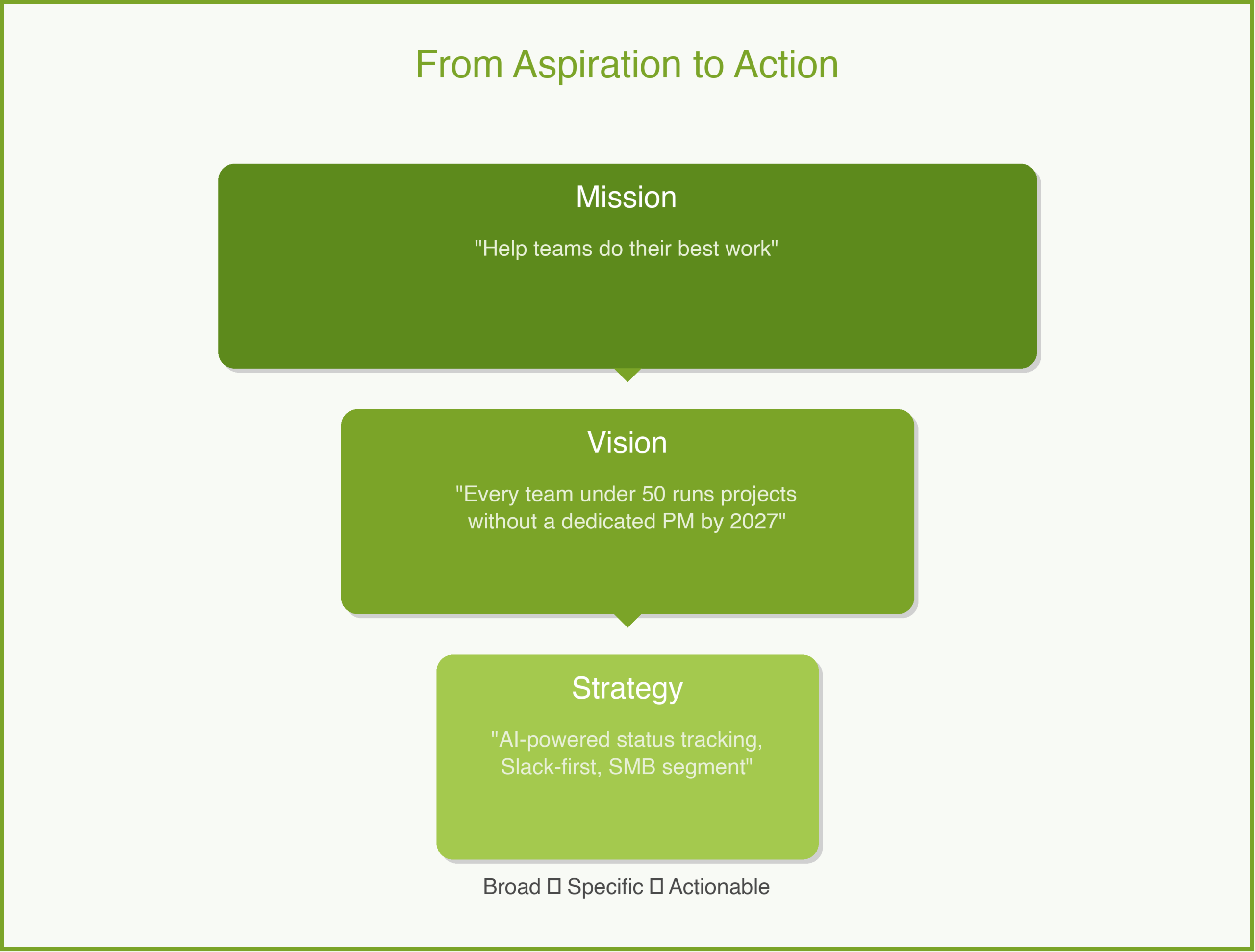
A product vision is a clear, compelling description of the future state your product will create for its customers. It is not a mission statement (that is the company’s “why”). It is not a strategy (that is the “how”). The vision is the “where” — the destination you are working toward.
| What it answers | Example | |
|---|---|---|
| Mission | Why do we exist? | “Organize the world’s information” |
| Vision | Where are we going? | “A computer on every desk and in every home” |
| Strategy | How will we get there? | “Win through product-led growth in SMB” |
Think of it this way: if the mission is the reason your company exists, the vision is the picture of what the world looks like when you succeed. It sits right below the mission in the Strategy Pyramid and above the goals and strategy that drive daily work.
The best product visions share a few qualities. They are concrete enough to guide decisions. They are ambitious enough to inspire effort. And they are short enough to remember. Microsoft’s original vision — “a computer on every desk and in every home” — is the classic example. It was specific. It was bold. And it told every engineer at the company exactly what they were building toward.
The Components of a Strong Product Vision
Getting from a vague aspiration to a vision that drives behavior takes work. Here is the process I have found useful.
1. Start with the Customer Problem
The vision is not about your product. It is about the change your product creates in your customer’s life. The most common mistake I see is teams writing a vision that describes what the product does (“the leading analytics platform”) instead of what it changes for the customer (“every owner decides in 5 minutes”). Before you write anything, answer: What does the world look like for your customer today, and what will it look like when your product succeeds?
This is the hardest part. It requires genuine empathy and specificity. “Businesses will be more efficient” is not a vision. “Every small business owner closes their books in 10 minutes, not 10 hours” is.
2. Define the Future State
Write a description of the ideal future, 3-5 years out, as if your product has succeeded. Be concrete. Name the change. Describe what the customer is doing differently.
Amazon uses the “press release from the future” technique, originally described by Ian McAllister. Before building anything, the team writes a mock press release announcing the finished product. This forces you to articulate the customer benefit in plain language before you get lost in technical details.
3. Make It a Constraint
A vision is only useful if it helps you say “no.” If your vision is so broad that it justifies every feature request, it is not doing its job. The best visions are specific enough to eliminate options.
Spotify’s vision centered on “enabling human creativity to reach its full potential.” That guided them to build tools for podcast creators and musicians. It also guided them away from becoming a general social network, even though they had the user base for it.
4. Choose a North Star Metric
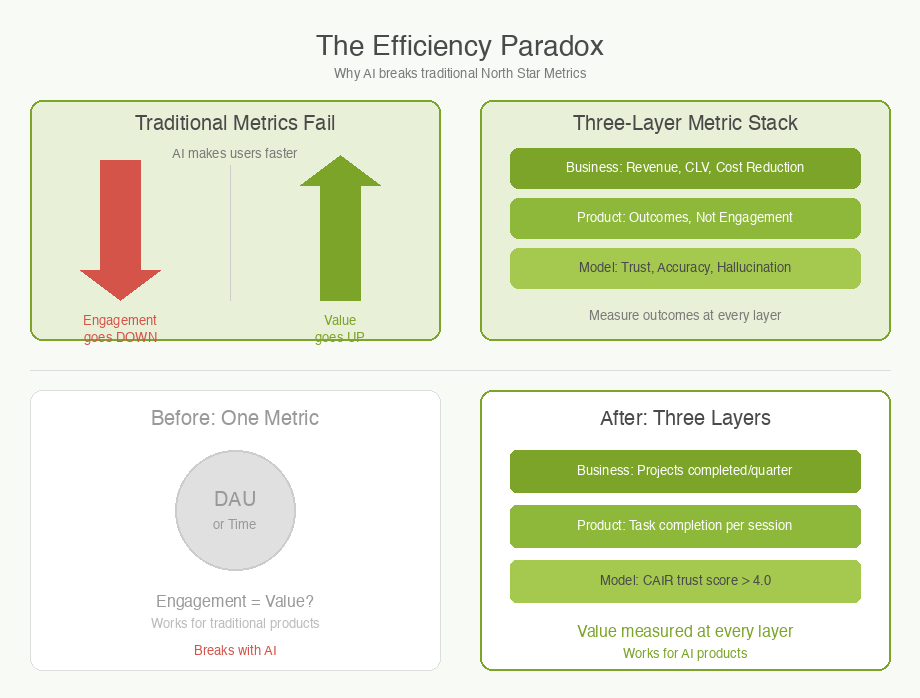
A North Star metric is the single number that best captures the core value your product delivers to customers. It connects the abstract vision to something you can measure every week.
For a project management tool, the North Star might be “weekly active projects” — not revenue, not signups, but a measure of whether people are actually using the product to do meaningful work. For a marketplace, it might be “weekly transactions completed.” The metric operationalizes the vision. It turns aspiration into accountability.
5. Evangelize Relentlessly
A vision that lives in a slide deck nobody opens is not a vision. It is a document. In my experience, the PM’s most important job is making the vision a living part of how the team thinks and decides.
This means repeating the vision in every kickoff, every sprint review, every roadmap discussion. It means connecting individual features back to the vision: “We are building this notification system because our vision says teams should ship with confidence, and right now they are missing critical updates.” It sounds repetitive. It is. That is the point.
A Concrete Example: DataFirst
To make the discussion more concrete, let’s pick a specific example. Imagine a startup called “DataFirst” that builds a data analytics platform for small e-commerce businesses. They are pre-product-market-fit, with 200 beta users and a team of 12.
Their founder keeps saying the vision is “to democratize data.” That is a fine aspiration, but it does not help the team decide what to build next. Every analytics feature “democratizes data.”
Here is how they might sharpen it:
- Customer problem today: Small e-commerce owners spend hours in spreadsheets trying to figure out which products to restock, which ads to cut, and whether they are actually profitable. Most give up and go with gut feel.
- Future state (3 years out): Every e-commerce owner with fewer than 50 employees makes confident, data-backed decisions about inventory, marketing, and profitability in under 5 minutes a day — without needing a data analyst.
- Vision statement: “Every small e-commerce owner makes confident decisions in 5 minutes a day.”
- North Star metric: Daily active decision-makers (users who take an action based on a DataFirst recommendation in a given day).
- What it constrains: This vision says “no” to enterprise features, custom dashboards, and complex query builders. It says “yes” to opinionated recommendations, mobile-first design, and one-click actions.
See how the specific vision is actually more useful than “democratize data”? It tells the engineering team to optimize for speed, not depth. It tells the designer to prioritize mobile. It tells the PM to build recommendations, not raw charts.
Here is what changed in practice: when a customer asked for a custom SQL query builder, the team said no in five minutes instead of debating for two weeks. When an engineer proposed a complex analytics engine, the PM pointed to “5 minutes a day” and asked, “Will the average store owner with 15 employees use this?” The answer was no, so they built a simpler recommendation widget instead. That is the difference between a vague vision and a sharp one.
The Vision-Strategy Gap
I want to highlight something I see often: teams that have a clear vision and clear action plans, but nothing connecting them. The vision says “every team ships with confidence” and the sprint backlog says “fix the CSV export bug.” There is a gap in the middle.
The product strategy is what fills this gap. It translates the aspirational language of the vision into the tactical language of the roadmap. Without it, the vision floats above the daily work like a poster on the wall — visible but irrelevant.
A quick diagnostic: ask three people on your team to explain how their current sprint connects to the product vision. If they cannot draw a clear line in under 30 seconds, you have a vision-strategy gap.
In the 5Ps framework, the vision lives in the Plan pillar. It feeds into the product strategy, which feeds into goals and initiatives, which feed into the features and sprints you work on every day. Each layer provides context for the layer below it.
Why This Matters
A strong product vision matters for three practical reasons.
It gives the team autonomy. When people understand where you are going and why, they can make good decisions without asking permission. The designer does not need to ask the PM whether to simplify the onboarding flow — the vision already answers that question.
It makes saying “no” easier. Every product team drowns in requests. A clear vision is the filter. “Does this move us toward our vision?” is the most powerful question a PM can ask.
It attracts the right people. I once watched a candidate’s face light up during an interview when the hiring manager described the product vision in one sentence. The candidate said, “That is exactly the problem I want to spend the next three years solving.” A compelling vision is a recruiting tool. “We are building a world where every small business owner makes confident decisions in 5 minutes a day” is a lot more motivating than “we are building a dashboard.”
How to Use With AI
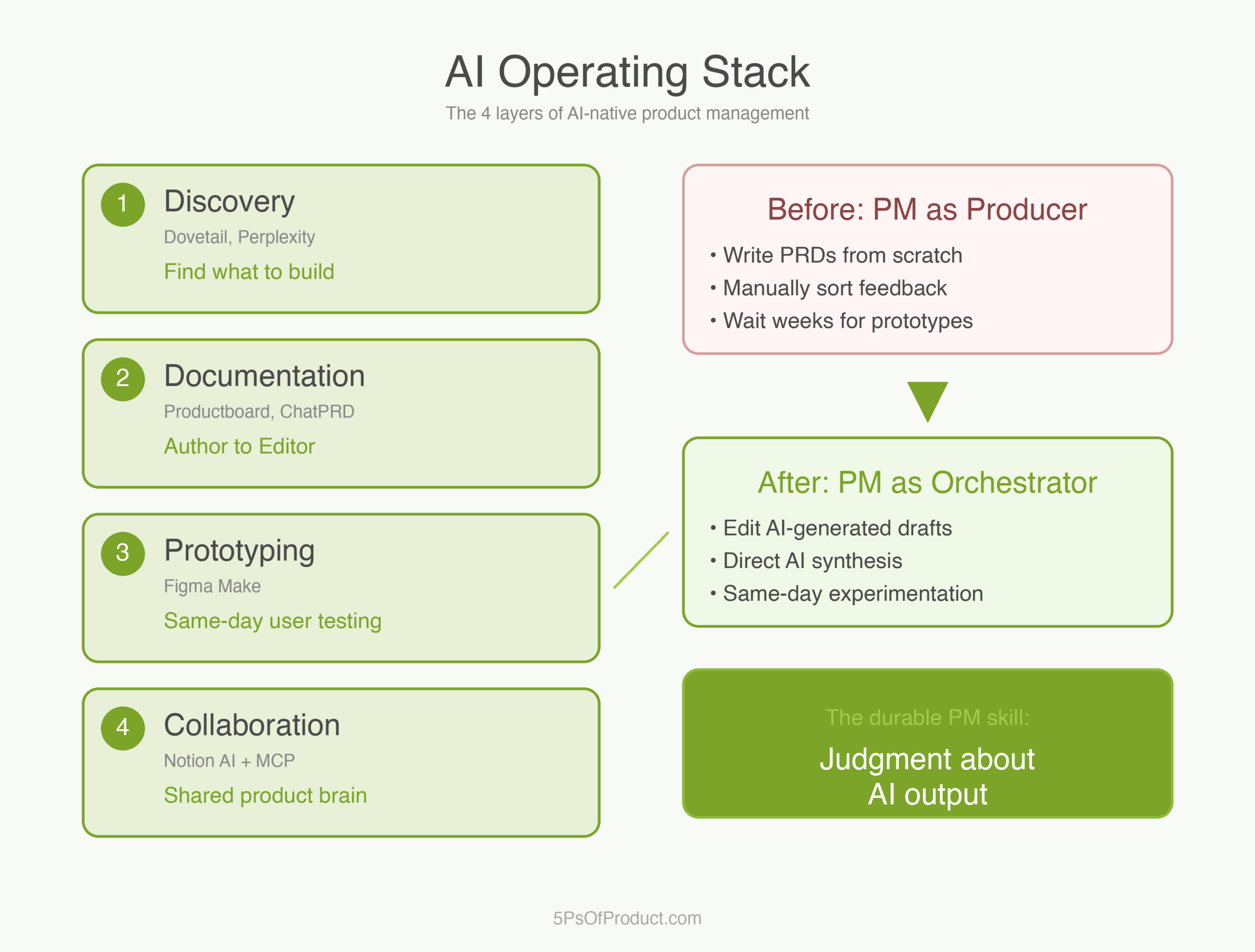
AI is surprisingly good at the parts of vision work that teams find tedious: synthesizing scattered inputs, generating options, and stress-testing language. Here is how I have seen PMs use AI effectively in this process.
Draft a vision from messy inputs. Feed your AI tool (Claude, ChatGPT, or a product-specific tool like Productboard’s AI features) your last strategy memo, customer interview notes, and competitive analysis. Ask it to propose three candidate vision statements. For example: “Here are our last 3 strategy memos and 5 customer interview summaries. Propose 3 product vision statements that are specific enough to help us say no to feature requests. Each should be under 15 words.” You will probably not use any of them verbatim, but they compress the blank-page phase from hours to minutes.
Write the “press release from the future.” Give the AI your target customer, the problem you are solving, and your rough timeline. Ask it to write a one-page press release announcing your product’s success. This is the technique Amazon uses internally, and AI produces a solid first draft that the team can then debate and refine.
Stress-test for specificity. Paste your draft vision into the AI and ask: “What products or companies could this vision also describe?” If the answer is “dozens,” your vision is too generic. Ask the AI to suggest more specific language.
Generate a North Star metric. Describe your product and vision, then ask the AI to propose five candidate North Star metrics with the trade-offs of each. Tools like Miro AI can help visualize how these metrics connect to your broader strategy on a shared canvas.
Guardrail: Never let the AI make the final call on your vision. The vision is an identity choice — it reflects what your team believes and what you are willing to sacrifice. AI can synthesize and sharpen, but humans must choose. If DataFirst had let AI write their vision, it might have suggested the safe, generic “democratize data” — exactly the kind of vision that sounds good but constrains nothing.
Conclusion
A product vision is not a decoration. It is a decision-making tool. The best ones are specific enough to constrain, ambitious enough to inspire, and short enough to repeat in every meeting without boring your team.
The process does not need to be complicated. Start with the customer problem. Describe the future state. Choose a North Star metric. Then repeat the vision until your team can recite it from memory.
This is not a cookie-cutter template. You will need to adapt these specifics to your context. A business-to-business enterprise product needs a different vision than a consumer app. A startup needs a different level of ambition than a team inside a large company.
But the underlying principle is the same: clarity of destination creates speed of execution.
What do you think? Comments are gladly welcome.
Leave a Reply
You must be logged in to post a comment.