
Over the past 15 years, I have found that the biggest cause of friction in product teams isn’t a lack of talent or effort. It is a lack of context. It all starts with the Mission: Why does the company exist? When that answer isn’t clear, everything downstream suffers. Engineers argue about features because they don’t see the strategy. Product managers argue about strategy because they don’t see the vision. And executives wonder why the roadmap doesn’t move the needle on the company goals.
We often talk about “alignment,” but alignment is impossible if we don’t have a shared map of where we are going and why.
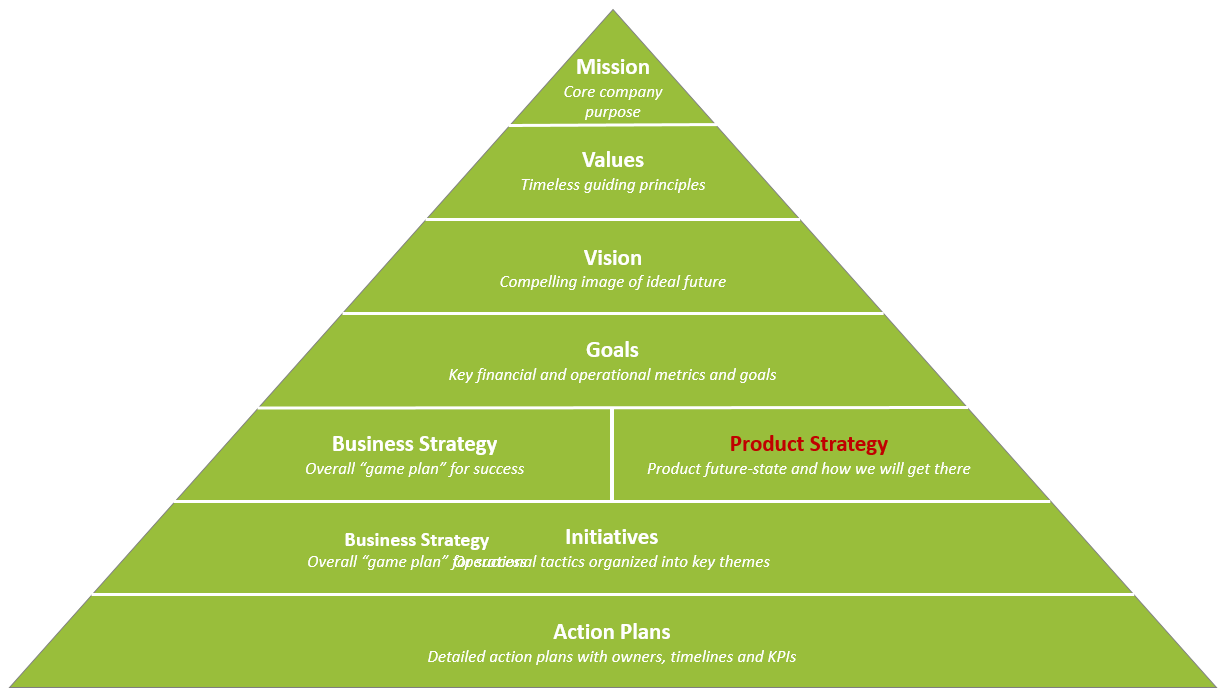
In developing the overall strategy for a company to provide context for the product strategy, one best practice is to express the components at different levels in a Strategy Pyramid. This simple visual framework has been what works best for me to get everyone—from the CEO to the newest intern—on the same page.
Critically, this framework is not meant to be onerous or slow things down. It is meant to provide clarity so you can move faster. The amount of detail should depend on your context. If you are a solopreneur, your entire Strategy Pyramid might be a half-page Google Doc. It is still helpful. At a larger company, it will need to be more detailed, with clear communication to the various teams.
What is a Strategy Pyramid?
A strategy pyramid lays out the key components of the strategic planning process for 5Ps Of Product. The concept draws on the classic strategic planning hierarchy described by authors like Michael Porter and Roger Martin, adapted here to create a product-focused process.
The idea is simple: strategy is a hierarchy. You can’t decide what to do today (Action Plans) if you don’t know how you plan to win (Strategy). And you can’t define a winning strategy if you don’t know why you exist (Mission).
The Components
Let’s walk through the pyramid from the top down. Each layer provides the constraints and context for the layer below it.
1. Mission
The “Why”
At the very top is the Mission. Why does the company exist? This is your core purpose. It rarely changes. It is the North Star that guides the ship through storms and calm waters alike.
Crucially, a Mission is not just “to make money.” Making money is a result, not a purpose. Your Mission is the positive change you want to bring to the world.
If your mission is “to organize the world’s information” (Google), that tells you immediately that you probably shouldn’t be building a toaster (unless it’s a very smart toaster).
2. Values
The “How” (Principles)
Right below the mission are your Values. These are the timeless guiding principles that dictate how you behave as you pursue your mission.
Think of Amazon’s famous “Customer Obsession.” It isn’t just a slogan; it is a mechanism that allows them to make decisions like offering free returns, even when it costs them money in the short term.
I have seen many companies treat values as posters on a wall. That is a mistake. Real values are decision-making tools. If one of your values is “Move Fast,” you might accept more bugs in production than a company whose value is “Reliability First.” Neither is wrong, but they lead to very different products.
3. Vision
The “Where”
The Vision is a compelling image of the ideal future. If the Mission is the “Why,” the Vision is the “Where.” What does the world look like in 5 or 10 years if you succeed? I dive deeper into crafting a vision that actually drives decisions in a separate article.
A classic example is Microsoft’s original vision: “A computer on every desk and in every home.” It was concrete, ambitious, and at the time, completely revolutionary. It painted a picture of the destination so everyone knew what they were aiming for.
4. Goals
The “What”
Now we get specific. Goals are the key financial and operational metrics that tell us if we are making progress toward the vision. These are usually time-bound.
The ultimate example is JFK’s goal for NASA: “Land a man on the moon and return him safely to the Earth before this decade is out.” It wasn’t vague. It was binary. You either did it or you didn’t.
Goals ground the lofty Vision in reality. They give us a scorecard.
5. Strategy (Business & Product)
The “Game Plan”
This is the pivot point of the pyramid. This is where many teams get stuck.
- Business Strategy: This is the overall “game plan” for the company’s success. It includes sales strategy, marketing strategy, operational strategy, and yes, product strategy. Tesla’s “Secret Master Plan” is a perfect example: Build a sports car -> Use that money to build an affordable car -> Use that money to build an even more affordable car.
- Product Strategy: This is the specific plan for the product’s future state and how it will help the business win. Think of the original iPhone launch: Drop the physical keyboard to enable a full-screen, adaptable interface. That was a strategic choice to win by changing the rules of the game.
Notice that Product Strategy sits inside or alongside Business Strategy. It serves the business goals. A great product strategy that bankrupts the company is a bad business strategy.
6. Initiatives
The “How” (Tactics)
Initiatives are operational tactics organized into key themes. These are the big rocks you are moving.
When Netflix decided to pivot to original content (starting with House of Cards), that was a massive Initiative. It wasn’t just “buy more movies”; it was a fundamental shift in how they operated to support their strategy of becoming a global TV network.
Initiatives group your efforts so you aren’t just reacting to random requests. They focus your energy on the areas that matter most for the Strategy.
7. Action Plans
The “Now”
Finally, at the base of the pyramid, we have Action Plans. These are the detailed plans with owners, timelines, and Key Performance Indicators (KPIs). This is the roadmap. This is the sprint plan. This is the JIRA ticket—often written as a user story—you are working on today.
For that Tesla engineer working on the Model S, the Action Plan wasn’t just “design a door handle.” It was “design a flush door handle that reduces drag (Strategy) to increase range (Goal) so we can prove electric cars are viable (Vision).”
A Concrete Example: ProjectFlow
To make the discussion more concrete, let’s pick a specific example. Imagine a company building a project management tool called “ProjectFlow.” They are a small startup trying to break into a crowded market.
Here is how their Strategy Pyramid might look:
- Mission: To help teams build better things together.
- Values:
- Simplicity over power: We will remove features if they make the product harder to learn.
- Transparency by default: Everyone sees everything unless explicitly hidden.
- Vision: A world where no project fails due to miscommunication. We want to be the default “operating system” for modern creative teams.
- Goals: Reach 1,000 paying teams by the end of the year. This gives us the revenue to hire our next two engineers.
- Business Strategy: Win the SMB market by undercutting enterprise tools on price and beating them on ease of use. We will rely on product-led growth (PLG) rather than a sales team. (This is where your Go-to-Market strategy lives.)
- Product Strategy: Build the fastest, most intuitive interface in the market. Focus on “zero-setup” collaboration so a team can start working in seconds, not days. We explicitly choose not to build complex reporting or permissioning features yet.
- Initiatives:
- “Instant Onboarding”: Reduce time-to-first-project to < 1 minute.
- “Mobile First”: Full feature parity on iOS/Android to support remote teams.
- “Viral Loops”: Build “guest access” features that encourage users to invite external clients.
- Action Plans:
- PM: Write specs for “One-click Google Sign-in” to support Instant Onboarding.
- Eng: Refactor the database for faster mobile sync to support Mobile First.
- Design: Simplify the “New Project” modal to remove mandatory fields.
See how it flows? If a designer proposes a complex, powerful feature like “Gantt Chart Dependencies” that requires manual setup, the PM can point to the Values (“Simplicity over power”) and the Strategy (“Zero-setup”) and say, “That’s a great idea, but it doesn’t fit our current strategy. We are optimizing for speed, not complexity.”
The Product Strategy Bridge
I want to highlight the Product Strategy component specifically. In my experience, this is often the missing link.
Teams often have high-level Goals (“Make money”) and low-level Action Plans (“Build feature X”), but nothing in between. They lack the “connective tissue” that explains why feature X leads to making money.
The Product Strategy provides that bridge. It translates the financial language of the Business Strategy (“Capture 20% market share”) into the language of the product (“Build a viral loop through free guest access”).
Why This Matters
Using a Strategy Pyramid isn’t just about filling out a template. It is about communication.
When I join a new team, I often ask people to draw this pyramid for their product. Usually, the top is fuzzy (“Something about making the world better?”) and the middle is missing. Everyone knows the Action Plans (the bugs they are fixing today), but they have no idea how it connects to the top.
By explicitly writing this down, you give your team a tool to make decisions. You empower them to say “no” to things that don’t fit the strategy. You give them the context they need to be autonomous.
How to Use With AI
Gen AI is surprisingly good at the part of strategy work that teams hate: turning scattered context into a clean draft. Use it like a tireless facilitator, not a CEO. Feed it your raw inputs, ask it to propose a first-pass Strategy Pyramid, then review it live with the team and force the hard choices in the open. The goal isn’t to let AI decide your mission. It’s to compress the “blank page” phase and spend more human time on the debates that actually matter.
Draft the first pyramid from messy inputs: give it your last 3 strategy memos, a recent roadmap, and notes from customer calls, then ask for a one-page Mission → Values → Vision → Goals → Strategy → Initiatives → Action Plans draft.
Stress-test alignment: ask it to flag contradictions (example: “Simplicity over power” vs “enterprise permissioning initiative”) and list the decisions you’re implicitly making.
Generate a “strategy narrative” for comms: have it produce a one-minute version for execs, a one-pager for the org, and a team-level “what changes Monday” summary.
Turn the pyramid into an operating cadence: ask for a quarterly review agenda and the top 10 questions each layer should answer.
Guardrail: never accept AI wording for Mission/Values blindly. Those are identity choices. Use AI for synthesis and clarity, then make the final call as humans.
Conclusion
This framework is what has worked for me to bring order to chaos. It pushes you to be disciplined about your thinking. You can’t just hand-wave the strategy if you need to write it down in a box that sits between Goals and Initiatives.
This is not a cookie-cutter template. You will need to adapt these specific labels to your context. Maybe you call “Initiatives” “Themes” or “Bets.” That’s fine. The important thing is the hierarchy of context.
What do you think? Does your team have a clear path from Mission to Action? Comments are gladly welcome.
Leave a Reply
You must be logged in to post a comment.