
A few years into my product career, I joined a team that was building a project management tool for creative teams. We had a solid product, loyal users, and a clear roadmap. Then a competitor launched a free tier that undercut our pricing by half. Within three months we lost 20% of our trial conversions. The product hadn’t changed. The market had.
That was the moment I learned that understanding your product in isolation is not enough. You need to understand the environment it lives in. Competitive analysis is how you do that.
What Is Competitive Analysis?
Competitive analysis is the practice of systematically studying the companies, products, and alternatives your customers consider instead of yours. It is not corporate espionage and it is not obsessing over feature parity. It is understanding the choices your customers face so you can position your product in a way that matters.
In the 5Ps framework, competitive analysis sits in the Problem phase. Before you can define a solution, you need to understand the full problem space, and that includes knowing what solutions already exist. A problem that already has ten good answers is a very different challenge than one nobody has tried to solve.
This feeds directly into your Strategy Pyramid. You cannot set a credible product strategy without knowing what you are up against. And it connects to your product vision, because a vision that ignores the competitive reality is just a wish.
Why Most Competitive Analysis Falls Short
Here is what I see go wrong most often: teams treat competitive analysis as a one-time exercise. Someone builds a spreadsheet comparing features. The spreadsheet gets presented in a meeting. Then it sits in a shared drive collecting dust until a sales rep asks for it six months later.
The problem with this approach is that markets move. Competitors ship new features, change pricing, acquire companies, and pivot their positioning. A snapshot from six months ago is not analysis. It is archaeology.
The other common mistake is focusing exclusively on features. Feature matrices are comforting because they are concrete and measurable. But customers rarely choose a product based on feature count. They choose based on how well a product solves their specific problem, how much it costs, how easy it is to adopt, and whether the company behind it feels trustworthy. None of that shows up in a feature checklist.
The Four Dimensions of Competition
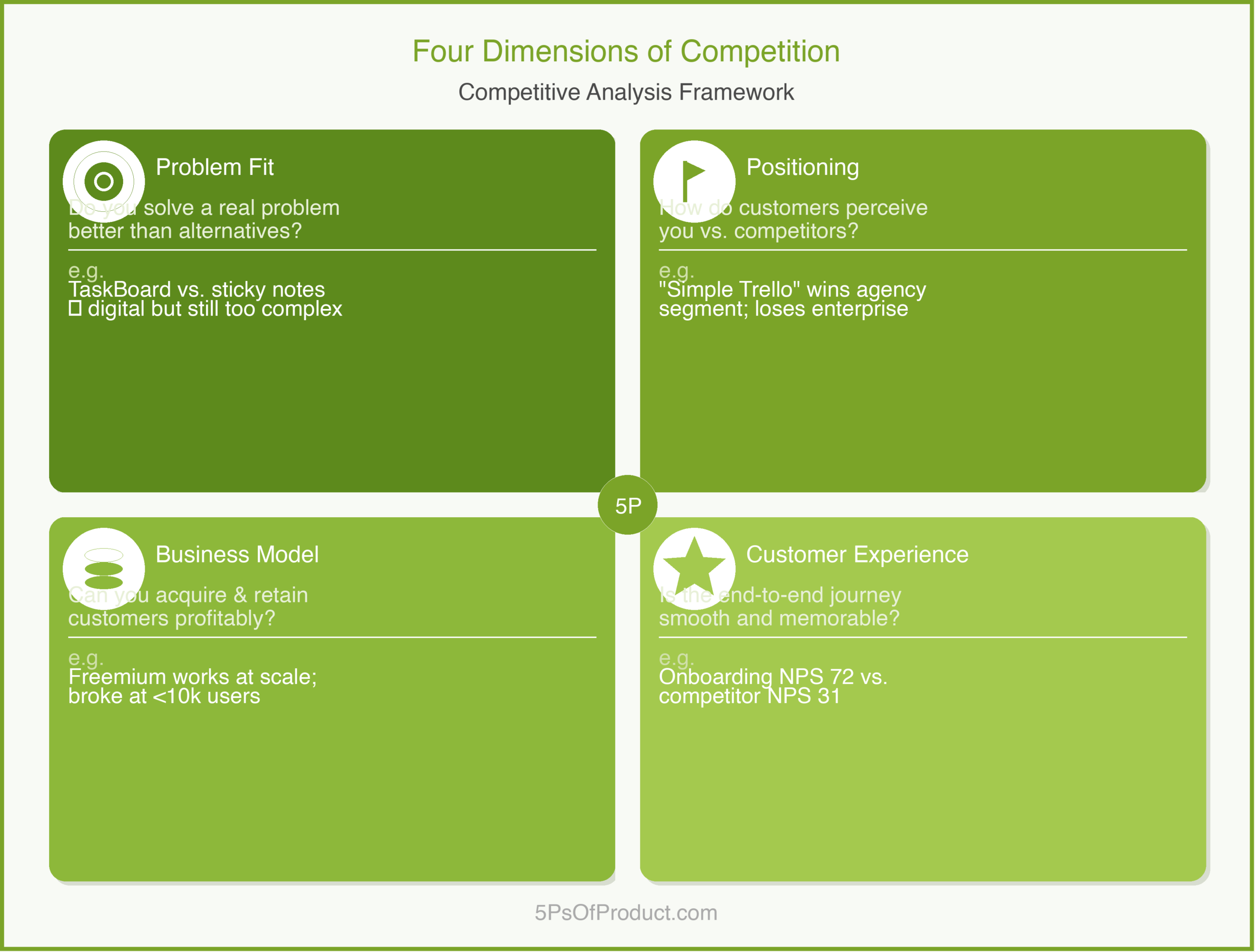
In my experience, meaningful competitive analysis covers four dimensions. Features are one of them, but only one.
1. Problem Fit
What problem does each competitor solve, and for whom? Two products might look similar on the surface but target completely different segments. Basecamp and Jira are both “project management tools,” but they serve different audiences with different workflows. Understanding this distinction matters because it tells you where there is room to differentiate and where there is not.
2. Positioning and Messaging
How does each competitor describe itself? What do they emphasize in their marketing? What do they leave out? Positioning reveals strategic choices. If a competitor leads with “enterprise-grade security,” they are probably targeting regulated industries. If they lead with “get started in 30 seconds,” they are targeting individuals and small teams.
3. Business Model
How does each competitor make money? Pricing structure, free tiers, contract length, upsell paths. Business model differences create strategic openings. If every competitor charges per seat, a flat-rate model might be the differentiator that wins teams with large headcounts.
4. Customer Experience
What do real users say about each product? Review sites like G2 and Capterra are goldmines for this. Look for patterns in complaints and praise. If every competitor’s users complain about the same thing, that unmet need is your opportunity.
A Concrete Example: TaskBoard
Imagine a B2B SaaS company called “TaskBoard” that builds a lightweight project management tool for marketing teams. TaskBoard’s PM sits down to do a competitive analysis and maps five competitors across the four dimensions.
Problem Fit: Two competitors target engineering teams specifically. One targets agencies. Two are horizontal tools. TaskBoard targets marketing teams — the engineering-focused tools are not true competitors despite having similar features.
Positioning: The agency tool emphasizes client collaboration. The horizontal tools emphasize flexibility. Nobody is positioning around marketing-specific workflows like campaign planning and content calendars. That is a gap.
Business Model: Three charge per seat. One charges a flat rate per workspace. Marketing teams tend to be large — a flat-rate model might be more attractive.
Customer Experience: Reading 200 reviews on G2, a clear pattern emerges: users love flexibility but hate setup time. Marketing teams want opinionated templates, not blank canvases.
The analysis shapes three strategic decisions: marketing-specific templates as a core differentiator, testing flat-rate pricing, and positioning around time-to-value. None of these would have been obvious from a feature comparison alone.
Keeping It Alive
The most useful competitive analyses are living documents, not one-time reports. Here is what has worked for me:
Set a cadence. Review your competitive landscape quarterly. Markets change, and your analysis should change with it.
Assign ownership. Someone on the team should own the competitive brief. Without ownership, it drifts.
Use win/loss interviews. Talk to customers who chose a competitor. Ben Horowitz describes this well in The Hard Thing About Hard Things: the data you need most is the data that is hardest to hear.
Feed it into your roadmap. Every quarterly review should end with: “Given what we know, should our priorities change?”
The Differentiation Trap
One nuance that took me years to appreciate: competitive analysis is not about copying what works for others. It is about finding where others have made trade-offs that leave room for you.
Every product makes trade-offs. A competitor that optimizes for enterprise features will inevitably sacrifice simplicity. Michael Porter’s work on competitive strategy makes this point clearly: strategy is about choosing what not to do. Your competitive analysis should help you find the trade-offs your competitors have made and decide whether the opposite trade-off serves a segment they are underserving.
The danger is benchmarking yourself into mediocrity. If you add every feature your competitors have, you end up with a bloated product that does everything adequately and nothing well. The goal is not parity. It is clarity about where you win.
How to Use With AI
AI is remarkably good at the mechanical parts of competitive analysis. It cannot make strategic decisions for you, but it can accelerate the research that informs those decisions.
1. The Review Synthesizer
Reading hundreds of competitor reviews on G2 is tedious but valuable. AI can compress weeks of reading into hours.
The Workflow:
1. Export reviews for 2-3 key competitors.
2. Prompt: “I have pasted 100 G2 reviews for [Competitor]. Group the complaints into 3-5 themes based on the underlying problem. For each theme, estimate what percentage of reviews mention it and quote one representative review.”
2. The Positioning Decoder
Competitor websites are carefully crafted to emphasize strengths and hide weaknesses. AI can help you read between the lines.
The Workflow:
1. Paste the competitor’s homepage copy, pricing page, and one case study.
2. Prompt: “Based on this messaging, who is this product’s ideal customer? What problem are they solving? What are they deliberately not mentioning?”
3. The Gap Finder
Once you have mapped your competitive landscape, AI can help identify white space.
The Workflow:
1. Summarize each competitor’s positioning and top 3 strengths.
2. Prompt: “Given these five competitors, where are the gaps? Which customer segments are underserved?”
The Guardrail: AI has no access to your actual market data. It does not know your win rates or your customers’ willingness to pay. Every insight from AI-assisted competitive analysis must be validated against your own data. Use it to generate hypotheses, not conclusions.
Conclusion
Competitive analysis is one of those practices that separates strategic product management from reactive feature building. When you understand the landscape, you can make deliberate trade-offs. When you don’t, you end up chasing competitors into a go-to-market strategy that tries to be everything to everyone.
The goal is not to obsess over what others are doing. It is to understand the choices your customers face so you can give them a better one.
What do you think? How does your team approach competitive analysis? Comments are gladly welcome.
Leave a Reply
You must be logged in to post a comment.