
Most product management advice assumes you ship every two weeks. Agile sprints. Continuous deployment. Ship, measure, iterate. And for many software products, that advice is excellent.
But what if your development cycle is eighteen months? What if your “sprint” involves designing hardware, building tooling, running physical tests, and waiting for regulatory approval? What if changing direction mid-cycle isn’t a matter of rewriting code but of retooling a factory?
I spent several years working on products where the roadmap stretched to three years and beyond. The experience taught me that the same strategic principles apply — you still need a clear vision and a strategy pyramid — but the roadmapping mechanics are fundamentally different. You can’t “fail fast” when each experiment costs months and significant capital.
What Is a Technical Roadmap?
A technical roadmap is a plan that sequences architectural and engineering investments over an extended time horizon — typically one to five years. Unlike a feature roadmap, which lists what users will see, a technical roadmap describes what the team will build beneath the surface to enable future capabilities.
Think of it as the difference between planning a road trip (feature roadmap) and building the highway (technical roadmap). The highway needs to be designed before anyone can drive on it, and once you pour the concrete, changing the route is expensive.
The Core Challenge: Uncertainty Over Long Horizons
The fundamental tension in technical roadmap planning is that you are making binding decisions with incomplete information. In a two-week sprint, you can course-correct cheaply. In an eighteen-month development cycle, a wrong architectural bet can waste years of work.
This means technical roadmapping isn’t really about predicting the future. It is about managing the cost of being wrong.
The best technical roadmaps I have seen don’t try to be prophetic. They try to be resilient. They build in options — architectural choices that keep multiple futures open.
The Components
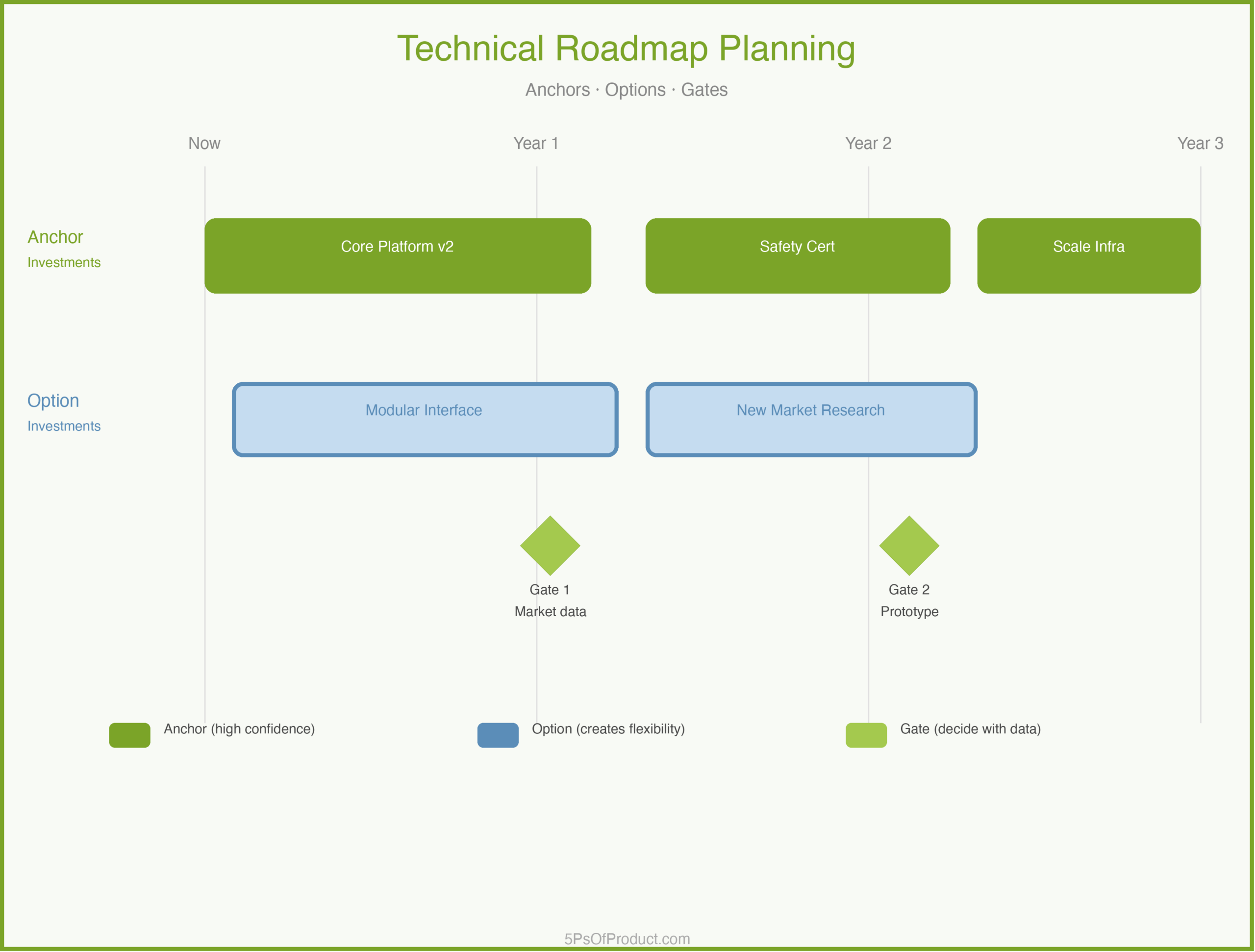
1. Anchor Investments
These are the bets you are making with high confidence. They align directly with your strategy and are unlikely to change regardless of how the market evolves. Anchors go on the roadmap first and get the most resources.
2. Option Investments
These are smaller, deliberate investments that create future flexibility without committing you to a specific path. They cost something now but give you the right — not the obligation — to move in a direction later.
A modular design is an option investment. It costs more upfront than a monolithic design, but it lets you adapt without redesigning the entire product.
3. Sequencing Gates
In long-cycle products, you need sequencing gates — decision points where you evaluate new information before committing to the next phase. The gate isn’t “did we hit a deadline?” It is “do we still believe this bet is correct given what we now know?”
A Concrete Example: SynthLabs
Imagine a company called “SynthLabs” that builds industrial automation hardware. Their product is a robotic arm with an eighteen-month development cycle from concept to production.
SynthLabs faces a classic roadmap tension. Their current product serves automotive manufacturers. Sales wants to expand into food processing. But the two industries have different requirements: automotive needs precision and speed; food processing needs washdown compliance and gentler handling.
Anchor Investments (High Confidence): Next-generation motor controller (needed regardless of industry). Safety certification for current platform. Core firmware upgrade.
Option Investments (Creating Flexibility): Modular end-effector interface — a standardized mounting system that lets them swap grippers without redesigning the arm. Environmental sealing research — a small team investigates washdown-rated enclosures. Not a full commitment to food processing, but enough to make a credible proposal.
Sequencing Gates: Gate 1 (Month 6): Review food processing market data. Gate 2 (Month 12): Prototype of modular interface tested. Gate 3 (Month 15): If food processing proceeds, commit to specialized certification.
SynthLabs doesn’t commit to the food processing market on day one. They invest in optionality so that when Gate 1 arrives, they can decide with six months of data instead of guessing.
The Platform Debt Trade-Off
Long-cycle products accumulate “platform debt” — architectural choices that were right when made but now constrain future options. Every technical roadmap needs to budget time for paying down this debt.
The instinct is to defer platform work in favor of customer-visible features. For one cycle, you can get away with it. But the compounding effect is vicious. Skip a platform investment in Year 1, and by Year 3, every new feature takes twice as long.
The best approach I have seen is to reserve 20 to 30 percent of engineering capacity for platform work. This connects to the PRD process: every major architectural investment should have its own brief explaining the rationale and alternatives.
Why This Matters
Technical roadmap planning matters because the cost of getting it wrong is measured in years, not sprints. A bad feature in a SaaS app can be rolled back next week. A bad architectural bet in a long-cycle product means you live with it — or scrap months of work.
But the discipline also applies to software teams building long-lived platforms. If you are building infrastructure that other products depend on, you face the same long time horizons and binding commitments.
How to Use With AI
AI is useful for the analytical work that supports technical roadmapping — particularly dependency analysis and scenario planning.
1. Dependency Mapping
Technical roadmaps have complex interdependencies. Paste your roadmap items and ask AI to identify hidden dependencies.
Prompt: “Here are 15 items on our technical roadmap with estimated timelines. Identify any dependency chains where Item X must complete before Item Y can start. Flag items scheduled in parallel that appear to have dependencies.”
2. Scenario Planning
Long-horizon roadmaps benefit from “what if” analysis.
Prompt: “Here is our roadmap with anchor and option investments. Play out two scenarios: (1) the food processing market grows 30% and we enter, (2) it stays flat and we stay focused. For each, which option investments become anchors, and which become unnecessary?”
3. Gate Criteria Definition
When defining sequencing gates, AI can help articulate the criteria.
Prompt: “We need to decide at Month 6 whether to pursue a new market variant. What data points should we collect before this gate? Suggest 5-7 specific, measurable criteria for a clear go/no-go decision.”
Guardrail: AI can analyze dependencies and generate scenarios, but the strategic judgment about which bets to make belongs to humans who understand the market, the team, and the competitive dynamics.
Conclusion
Technical roadmap planning is a different discipline from agile feature prioritization. The time horizons are longer, the commitments are more binding, and the cost of changing direction is higher. But the core idea remains: sequence your investments so that you learn the most before committing the most.
What do you think? Comments are gladly welcome.