
Andrew Ng said something in a widely-cited 2025 interview that stopped me cold. One of his teams proposed flipping the traditional PM-to-engineer ratio on its head. Instead of one PM for every six engineers, they wanted one PM for every half an engineer. The reason? Engineers using AI-assisted coding were generating work so fast that the PM couldn’t evaluate it all. The bottleneck had moved.
I have been a product manager for over 15 years, and for most of that time the bottleneck was engineering capacity. There was never enough of it. PMs spent their days negotiating priorities, slicing scope, and horse-trading features across teams. That world is disappearing. And what’s replacing it demands a fundamentally different way of working.
What Is AI-Native Product Management?
There is an important distinction here that most people blur. Using ChatGPT to clean up your product requirements document (PRD) is “AI-enhanced” product management. You bolt a tool onto your existing workflow and keep doing what you were doing, a little faster. That’s fine. But it’s not what this article is about.
AI-native product management means redesigning how your team discovers, decides, and ships with AI embedded at every stage. It’s not a tool upgrade. It’s a workflow redesign. The difference is like the difference between putting a motor on a horse cart and designing a car from scratch.
O’Reilly’s Radar team identified three PM archetypes emerging from this shift. AI Builder PMs create AI-powered products. AI Experience PMs design how users interact with AI features. AI-Enhanced PMs use AI to do their existing job better. Most PMs I know are in that third category, which is a fine starting point. But the teams pulling ahead are the ones rethinking the work itself.
In the 5Ps framework, this sits squarely in the Platform P — the people, process, and infrastructure layer. How you structure your team, what tools make up your operating stack, what skills PMs carry forward. This is the 2025-2026 evolution of the Platform P’s central question: what does a high-functioning product team actually look like?
The AI Operating Stack
Here is a term I find useful: the “AI Operating Stack.” It’s the deliberate set of AI tools and workflows a product team assembles at the Platform layer. Not a random collection of subscriptions. A connected system where each tool serves a specific stage of the product development cycle.
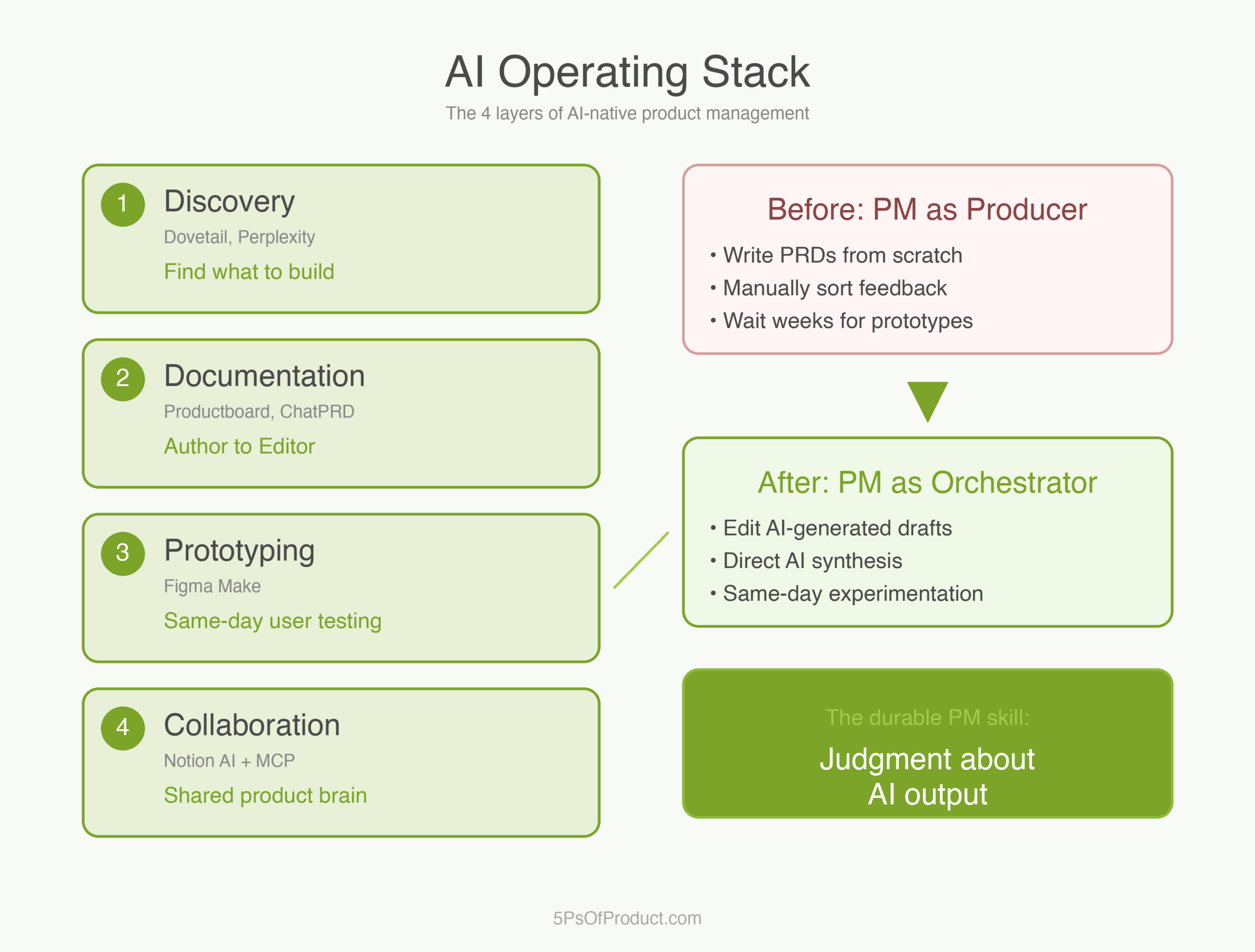
In my experience, the stack has four layers:
Discovery
This is where you figure out what to build. Tools like Dovetail auto-transcribe user interviews, cluster themes, and surface patterns that would take a human researcher days to find. Perplexity pulls real-time competitive data from Reddit, review sites, and news faster than manual research, and I use it before scheduling discovery calls to walk in already knowing the frustrations. The PM’s job shifts from manually sorting feedback to directing the synthesis and questioning what the AI misses.
Documentation
Productboard’s Spark AI agent ingests signals from Slack, support tickets, and sales calls, then clusters them and drafts context-aware PRDs. Tools like ChatPRD generate structured first drafts from brief descriptions. The shift here is from authoring to editing. You spend less time staring at a blank page and more time sharpening what the AI produces.
Prototyping
This one surprised me the most. Figma’s Make feature converts text prompts into clickable prototypes in seconds. A PM can now build a proof-of-concept and put it in front of users the same day an idea surfaces. No design queue. No two-week wait. That compression of time-to-feedback changes the economics of experimentation.
Collaboration
Notion’s team has gone deep here. They’ve built over 2,800 internal AI agents using MCP integrations that connect to Linear, Figma, and HubSpot. Brian Lovin, a product designer at Notion, built a shared prototype playground using Claude Code and a Next.js environment where the design team turns Figma files into working, testable code without engineering hand-offs. That’s not “AI-enhanced.” That’s a fundamentally different way of working.
What Changes About the PM Role
Here is what surprised me most. People assume AI mostly automates the boring stuff — data pulling, formatting, status updates. Lenny Rachitsky’s research found the opposite: AI most disrupts the high-level PM skills like strategy, vision, and PRD writing. The things we thought were uniquely human.
What becomes more valuable? The soft skills. Influence, product sense, stakeholder alignment, the ability to look at an AI-generated analysis and say “this is missing something.” Judgment about AI output turns out to be the durable PM skill.
Marty Cagan at SVPG has been tracking this closely. He notes that engineering teams are shrinking from eight to five or six as AI-assisted development improves productivity by 20-30%. But the PM role becomes more essential and more difficult, not less. Product sense and judgment matter more when AI handles the analytical load. For delivery-oriented product owners who mostly coordinate and project-manage, AI may automate many of those tasks entirely.
A Concrete Example: Ramp’s AI Agents
To make the discussion more concrete, consider what Ramp has done. Ben Levick, their Head of Ops and Internal AI, built over 300 Notion Custom Agents that now handle product and operational questions every day. Onboarding queries, product FAQs, internal enablement questions, all handled by agents that free up PM bandwidth for the work that actually requires human judgment.
This is not a theoretical exercise. It is a team that identified the repetitive, information-retrieval parts of PM work and deliberately moved them to AI. The PMs did not lose their jobs. They gained time for discovery, strategy, and the cross-functional alignment work that no agent can do.
Why This Matters
The numbers tell the story. McKinsey’s State of AI report found that 88% of organizations now deploy AI in at least one business function, up from 78% just a year prior. This is not a trend you can wait out.
But here is the thing I keep coming back to: the risk is not that AI replaces PMs. The risk is that PMs who build an AI Operating Stack will consistently outpace those who don’t. Cagan is honest about this. He says virtually all PMs will need to become “AI PMs.” The only question is how quickly your team makes the transition.
How to Use With AI
If you want to start building your own AI Operating Stack, here is a workflow I have found useful:
1. The Stack Audit
Start by mapping your current product development cycle end to end. For each stage, ask: where am I spending time on synthesis, formatting, or information retrieval that AI could handle?
Paste your actual weekly workflow into Claude or ChatGPT and ask it to identify every task involving synthesis, summarization, or information retrieval. For each one, ask for a specific AI tool that could handle 80% of it.
2. The Discovery Synthesis Workflow
Export your last 50 support tickets or sales call notes. Ask an AI to cluster them into 3-5 groups by underlying problem, naming the persona and frustration for each cluster. Then compare its clusters to your own intuition. Where they disagree is where the interesting insights live.
3. The PRD Editing Workflow
Stop writing PRDs from scratch. Give the AI a brief description and let it generate a first draft. Spend your time editing, questioning assumptions, and adding context only you have — competitive dynamics, internal politics, technical debt the AI doesn’t know about.
The Guardrail: Your AI Operating Stack should serve your team’s actual workflow, not the other way around. If you find yourself adapting your process to fit the tool, that’s a signal to reassess. And the strategic choices (which segment to target, what to build next, what to kill) remain human decisions. AI can inform them. It cannot make them for you.
Conclusion
AI-native product management is not about using more AI tools. It is about deliberately redesigning how your team discovers, decides, and ships, with AI embedded in the workflow from the start. The teams that treat this as a Platform question — how do we structure ourselves to work this way? — will pull ahead. The teams that treat it as a tools question — which AI should I subscribe to? — will keep bolting motors onto horse carts.
This is what I’m seeing work. Your context is different, and you will need to adapt these ideas to your team, your product vision, and your stage. But the direction feels clear to me: the PM role is becoming more about judgment and less about production. That is a good trade.
What do you think? I’d love to hear how your team is approaching this. Comments are gladly welcome.