
The best product launch I ever ran was completely uneventful on the day itself. No fire drills. No Slack channels blowing up. No frantic calls to engineering. Everything had already been done.
That might sound anticlimactic, but it took me years and several painful launches to get there. Early in my career, I treated launch day like an event — something exciting that happened all at once. The result was predictable: last-minute scrambles, sales teams finding out about features from customers, support agents reading the blog post at the same time as everyone else.
The lesson I learned is that a launch is not a day. It is a process. And if the process is right, the day is boring. That is the goal.
What Is a Product Launch Playbook?
A product launch playbook is a repeatable framework that coordinates everyone involved in bringing a product or feature to market. It covers what happens before, during, and after the public announcement.
This is different from a go-to-market strategy. Your GTM strategy answers the strategic questions: who is this for, why should they care, how will they find it? The playbook is the execution plan that turns those strategic answers into coordinated action across teams.
Think of it this way: the GTM strategy is the “what” and “why.” The playbook is the “who does what by when.”
The Three Phases
Every launch — whether it is a minor feature update or a major product release — follows three phases. The Product Marketing Alliance describes this as the Ready-Set-Go framework, and the ratio of effort across these phases surprised me when I first mapped it out.
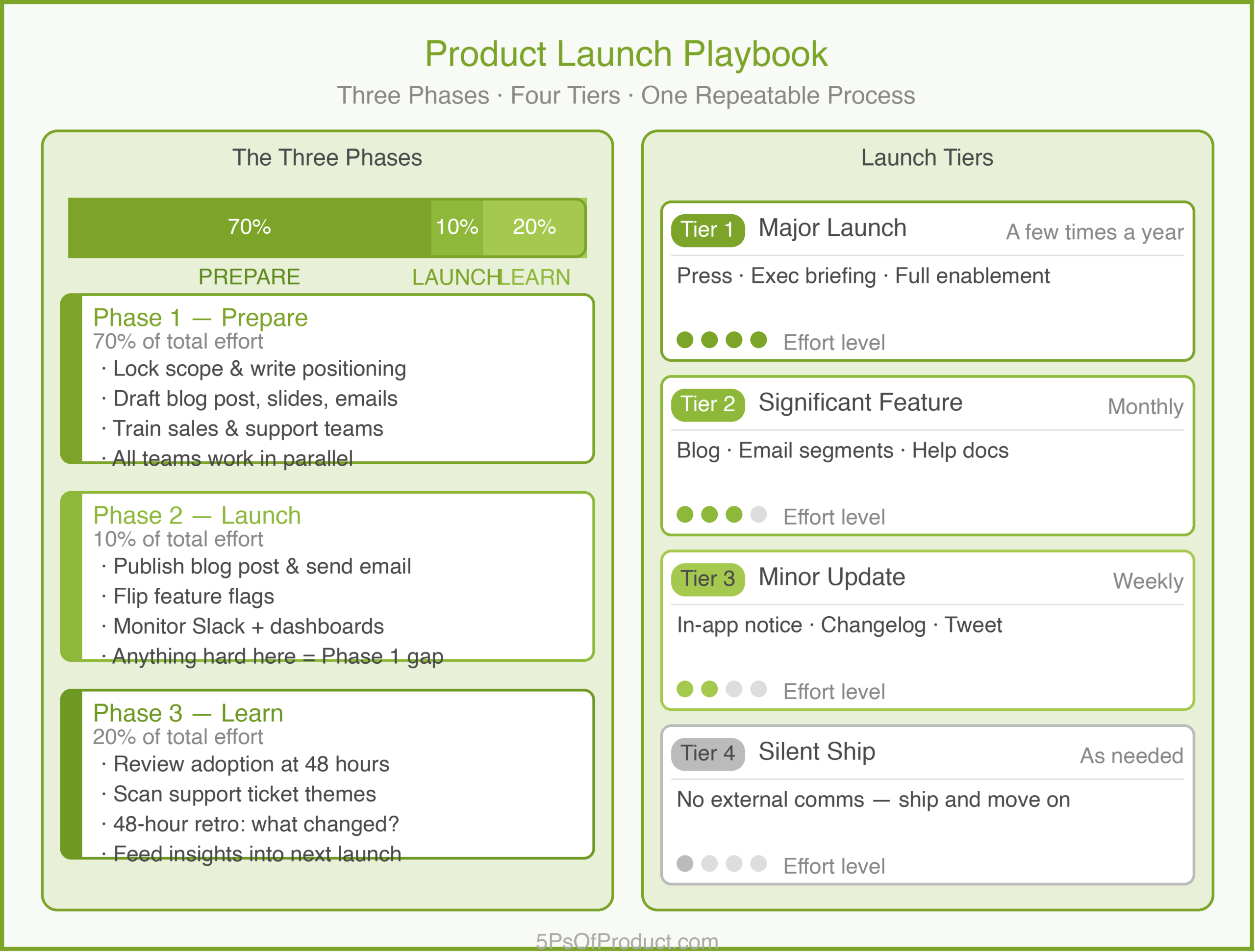
Phase 1: Prepare (70% of the work)
This is where most of the real work happens. By the time you reach launch day, 70% of the effort should already be done.
Preparation means different things for different teams. For product, it means locking the scope and writing the positioning — building on the customer segments you have already identified. For marketing, it means drafting the blog post, creating screenshots, and scheduling emails. For sales, it means updating the pitch deck and scripting objection handlers. For support, it means writing help center articles and training the team.
The key insight I picked up over the years is that all of these things need to happen in parallel, not sequentially. If you wait for marketing to finish the blog post before sales starts preparing, you have already lost a week.
Phase 2: Launch (10% of the work)
If Phase 1 went well, Phase 2 is just flipping switches. Publish the blog post. Send the email. Update the in-app messaging. Turn on the feature flag.
The reason this should only be 10% of the total effort is simple: anything that requires real work on launch day is a sign that preparation was incomplete. I have seen teams spend launch day writing documentation. That is a Phase 1 failure, not a Phase 2 problem.
Phase 3: Learn (20% of the work)
This is the phase most teams skip entirely, and it is the one that matters most for the next launch. Within the first 48 hours, you should be looking at adoption numbers, support ticket themes, and sales feedback.
I schedule a 48-hour retrospective for every launch. Not a big formal meeting — just a 30-minute check-in where we ask three questions: What went well? What caught us off guard? What would we change next time?
Launch Tiers: Not Every Launch Needs the Full Show
One of the biggest mistakes I see teams make is treating every launch the same. A small bug fix and a new product line should not get the same level of ceremony.
I use a tiering system that looks like this:
Tier 1 — Major Launch. A new product, a new market, or a fundamental change to the core experience. Full playbook: press outreach, executive briefing, sales enablement, support training, the works. These happen a few times a year at most.
Tier 2 — Significant Feature. A notable addition that changes how customers work. Blog post, email to relevant segments, updated help docs, sales talking points. No press, no big event. These happen monthly.
Tier 3 — Minor Update. A small improvement or iteration. In-app notification, changelog entry, maybe a tweet. No email blast, no sales training. These happen weekly.
Tier 4 — Silent Ship. A bug fix, performance improvement, or backend change. No external communication. Ship it and move on.
The tier determines how many of the playbook steps you actually execute. A Tier 3 launch doesn’t need a press kit. A Tier 1 launch doesn’t skip sales enablement. Matching the effort to the impact keeps your team from burning out on launches that don’t warrant it.
A Concrete Example: NoteStream
To make the discussion more concrete, let’s consider a specific example. Imagine a B2B SaaS company called “NoteStream” that sells a collaborative note-taking tool for product teams. They are about to launch their first AI-powered feature: automatic meeting summaries.
NoteStream’s PM classifies this as a Tier 1 launch — it is a new capability that changes the product’s value proposition. The feature was scoped using a detailed PRD and validated through customer interviews.
Here is how their playbook unfolds:
Prepare (Weeks 1-4): The PM writes the positioning: “Stop taking notes. Start making decisions.” Marketing drafts a blog post and a 60-second demo video. Sales gets a one-page battlecard comparing NoteStream’s AI summaries to competitors. Support writes five new help center articles. Customer success identifies 20 power users for early access.
Launch (Week 5): Monday: early access goes live for 20 users. Wednesday: blog post publishes. Thursday: email goes to all users, segmented by usage tier. The PM monitors the Slack channel for the first hour, then switches to watching the analytics dashboard.
Learn (Weeks 5-6): By day three, NoteStream sees that adoption is strong among teams with 5+ members but weak among solo users. Support tickets reveal that solo users don’t have meetings to summarize — the feature doesn’t match their workflow. The PM notes that the next iteration should include “async summary” for written threads, not just live meetings.
That post-launch insight is more valuable than any pre-launch planning could have produced. You only get it if you build the “Learn” phase into the playbook.
The Internal Launch: The Step Everyone Skips
Here is a pattern that has saved me more than once: launch internally before you launch externally.
An internal launch means that every customer-facing team — sales, support, customer success, and even finance — sees the feature, understands the positioning, and has had a chance to ask questions before a single customer does.
Research from Highspot found that 85% of go-to-market teams report frequent misalignment between sales, marketing, and R&D during launches. That number is staggering but it matches what I have seen. The fix is simple: give internal teams at least one week of lead time.
In that week, I run a 30-minute demo for each team. Not a generic all-hands presentation — a tailored session where I explain what it means for their specific role. Sales needs to know how to sell it. Support needs to know the edge cases. Customer success needs to know which accounts to proactively reach out to.
Why Most Launches Underperform
Harvard Business School professor Clayton Christensen’s widely cited research suggests that roughly 95% of new products miss their commercial targets. A separate study in Marketing Letters found that the failure rate sits closer to 40% by the end of the second year, depending on how you define failure. Either way, the odds are not great.
In my experience, the launches that underperform share a few common patterns:
They confuse “shipped” with “launched.” The code is live, but nobody outside engineering knows it exists. Features that ship without communication might as well not exist.
They skip the internal launch. Sales finds out from a customer. Support reads the blog post live. Everyone is reactive instead of proactive.
They launch to everyone at once. No segmentation, no phased rollout. The message that resonates with power users lands in the inbox of someone who signed up yesterday and hasn’t finished onboarding.
They never close the loop. There is no retrospective, no post-launch analysis. The same mistakes repeat on the next launch.
How to Use With AI
AI is not going to decide your launch tier or choose your positioning. Those are judgment calls that require context only you have. But AI is remarkably useful for the grunt work of launch preparation — the parts that take hours of effort but don’t require strategic insight.
1. The “Launch Brief Generator”
Instead of staring at a blank document, use AI to draft your launch brief from a feature spec.
The Workflow:
1. Paste your feature requirements or PRD.
2. Prompt: “Based on this feature spec, draft a launch brief that covers: target audience, key benefit, positioning statement, launch tier recommendation (major, significant, minor, or silent), and three potential objections customers might raise.”
3. Edit the output. The AI will get the structure right but the positioning generic. Your job is to sharpen it.
2. The “Cross-Team Checklist Builder”
Every team needs different things for a launch. AI can generate the first draft of a team-specific checklist in seconds.
The Workflow:
1. Describe the feature and its launch tier.
2. Prompt: “Generate launch checklists for these teams: Sales, Support, Marketing, and Customer Success. For each team, list 5-7 specific action items they need to complete before launch day. Include estimated time for each item.”
3. Send each team their checklist as a starting point.
3. The “Announcement Multiplier”
You need the same message in a dozen formats: blog post, email, in-app banner, social media, internal Slack announcement, sales one-pager. AI can transform one master message into all the variants.
The Workflow:
1. Write your core announcement — three sentences that capture the what, why, and for whom.
2. Prompt: “Transform this core announcement into: (a) a 200-word blog post intro, (b) a 3-sentence email subject line and preview text, (c) an in-app notification under 50 words, and (d) a Slack message for the sales team that includes one competitive differentiator.”
The Guardrail: AI is a preparation accelerator, not a strategy engine. It can draft your checklists, multiply your messaging, and simulate customer reactions — but it cannot tell you which segment to prioritize or whether this launch deserves Tier 1 treatment. Those decisions come from your understanding of the business, the market, and your customers.
Conclusion
A launch playbook is one of those tools that pays for itself the second time you use it. The first time, you are building the template. Every time after that, you are just filling it in.
The core idea is simple: do the work before launch day so that launch day itself is boring. Prepare thoroughly, launch calmly, learn deliberately. Match your effort to the launch tier. And always — always — launch internally before you launch externally.
Obviously this cannot be used as a cookie-cutter template for every team. Your tiers will differ. Your checklists will be longer or shorter. The important thing is to have a repeatable process instead of reinventing the wheel every time.
What do you think? I would love to hear how your team handles launches. Comments are gladly welcome.